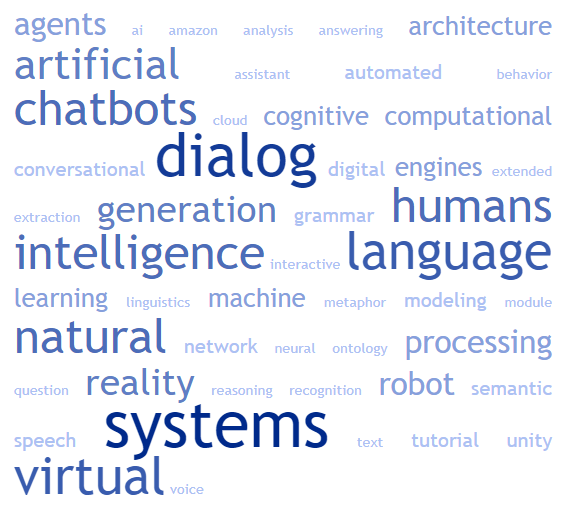
Meta-Guide.com has been described as a “treasure trove”. It is a semi-automated research machine, using artificial intelligence techniques to study A.I. (which is a prerequisite for singularity). Meta-Guide.com is semi-automated, tracking and automating, step by step, the processes of converting data into knowledge. Think of it as a human editable database, an exposed database, a database in the process of becoming a knowledgebase. Beginning in 2006, the decade long story of Meta-Guide.com is seared into social media, from Blogger, to Twitter, to Quora. Meta-Guide.com has been referenced in numerous academic papers, listed below.
|
Wikipedia:
References:
- Teaching Academic Writing In English To Students Of Economics Through Conceptual Metaphors (2022)
- Using Virtual Assistants as Relationship Marketing Instruments (2022)
- Utilization of Artificial Intelligence and Robotics Technology in Business (2022)
- Classification of answers and questions using natural language processing (2021)
- Neural Machine Translation for English to Hindi Using GRU (2021)
- A smart chat-bot (2020)
- Agent-based approach to hybrid modeling queuing systems (2020)
- Digital Transformation in Tourism (2020)
- Conceptual Metaphors in the Pentateuch Texts of English Bible (2019)
- ParlAmI: a multimodal approach for programming intelligent environments (2019)
- Deep Learning in Natural Language Processing (2018)
- Deep Learning in Spoken and Text-Based Dialog Systems (2018)
- IoT based smart interaction framework for elearning (2018)
- Toward Quality Assurance and Excellence in Higher Education (2018)
- Two analogy strategies: The cases of mind metaphors and introspection (2018)
- AWS for Developers For Dummies (2017)
- Business intelligence models (2017)
- Smart Home Automation Based on Voice Command Using Smart Phone (2017)
- Computer representations of bioinformatics models (2016)
- Digital Transformation in Tourism: a high level analysis of the impact that social networks and mass collaboration concept is having at tourism service providers (2016)
- Selected Examples of Applications of New Graphics and Animation Technologies (2016)
- The Relevance of Metaphoric Competence for Language Pedagogy (2016)
- Using the tree of Naive Bayesian classifiers to classify scientific publications (2015)
- Information Mining Technologies to Enable Discovery of Actionable Intelligence to Facilitate Maritime Situational Awareness: I-MINE (2013)
- Intelligent Personalized Searching (2013)
See also:
100 Best Meta Guides 2023 | Marcus Endicott’s Twitter Bot Timeline (2008 – 2015) | Meta Guide Index